Film Analysis and Review
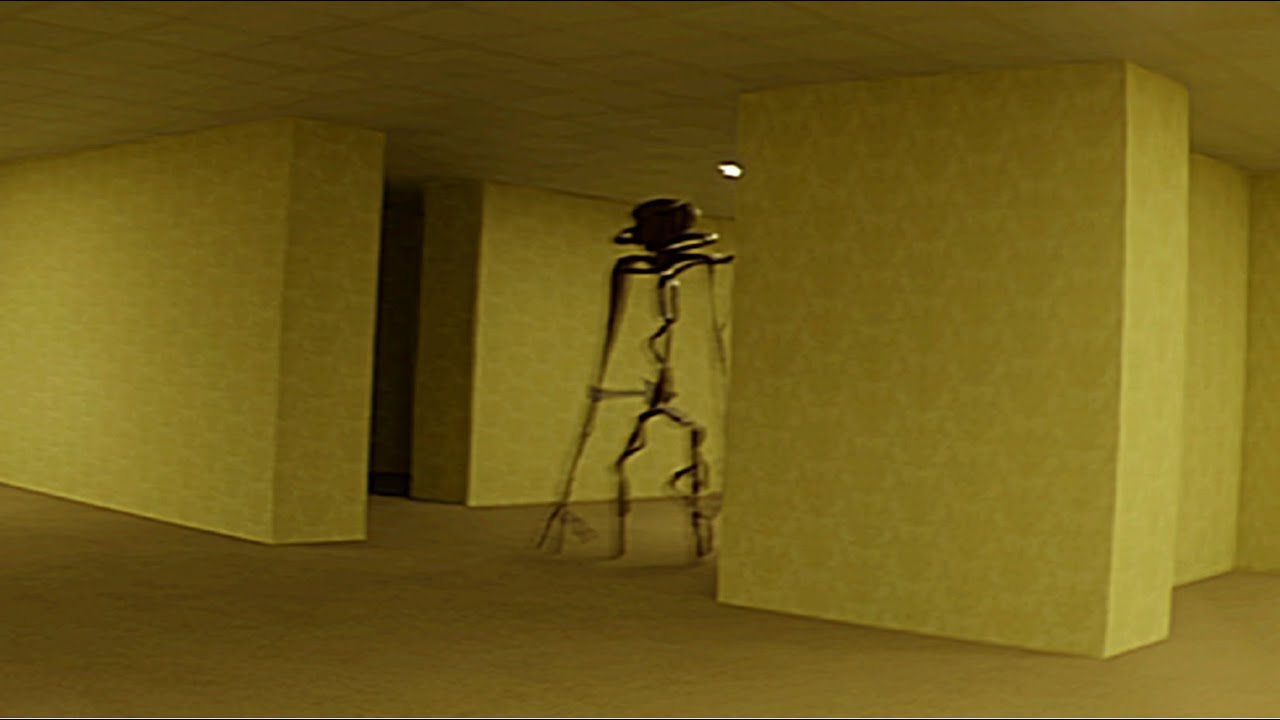
The Backrooms (Found Footage) does something that almost no horror film manages in its first sixty seconds: it makes the uncanny feel mundane. A cameraman on a student film set steps back for a wide shot. His foot finds nothing. He falls through the floor. And then he is somewhere else entirely — a vast, fluorescent-lit labyrinth of yellow walls and damp carpet that extends in every direction without logic, without exit, and without end.
What Kane Parsons understood, at sixteen, was that the horror of the Backrooms is not about what is in them. It is about the quality of the space itself. The corridors are not dark. They are brightly, horribly lit. The walls are not threatening. They are the exact shade of institutional beige that lines every waiting room, every school hallway, every forgotten office corridor you have ever moved through without thinking. The terror is not supernatural. It is the terror of a familiar space made infinite, stripped of purpose, emptied of human presence. The Backrooms are not a dungeon. They are a space that should have people in it, and does not.
The nine-minute runtime is not a constraint but a structural argument. Parsons gives us no backstory, no explanation, no mythology. We enter when the cameraman enters, we know what he knows, and we share his single, mounting dread: that the walls are not the only things in here. The creature design — glimpsed in peripheral wire-like movements, in the texture of something that should not be moving — is deployed with extraordinary restraint. We never see it clearly. We do not need to. The Backrooms themselves are the monster; what moves within them is merely the proof that the trap is occupied.
The sound design is the film's most precise instrument. Parsons scores the short almost entirely with the ambient hum of fluorescent tubes, the soft squelch of footsteps on damp carpet, and the specific, suffocating silence of a space that should echo but does not. When sound intrudes on that silence — a creak, a movement, a presence — it does not announce danger. It simply extends the dread that was already there.
The film was made in Blender and Adobe After Effects, with a VHS filter applied to disguise the CGI. That disguise works not because it is technically perfect but because Parsons understood something deeper: the grain, the tracking lines, the slight degradation of the image are not just aesthetic choices. They are epistemic ones. Found footage horror works when we believe the footage was found. The lo-fi presentation of The Backrooms (Found Footage) does not look like a student film. It looks like evidence.
Filmmaker Insight and Production Context
Kane Parsons was sixteen years old and had been making Attack on Titan fan animations when he turned his attention to the Backrooms. He took a month to build the film, working alone across Blender and After Effects, constructing every corridor, every flicker of fluorescent light, every stretch of damp carpet by hand. He uploaded The Backrooms (Found Footage) to YouTube on 7 January 2022.
Within days the video was trending. By the end of 2022 it had over 43 million views and had been listed in YouTube's US Trending Videos at number eight. By 2026 it had accumulated over 80 million. Parsons received a YouTube Streamy Award Creator Honor in February 2023.
What followed was a full web series — twenty-three episodes — that expanded the mythology into a coherent science fiction universe centred on the fictional Async Research Institute. And in February 2023, A24, Atomic Monster (James Wan), Chernin Entertainment, and 21 Laps Entertainment announced a feature film adaptation with Parsons directing — making him A24's youngest ever feature director.
The A24 feature Backrooms opened in theatres on 29 May 2026, starring Chiwetel Ejiofor, Renate Reinsve, and Mark Duplass. Critics described it as a haunting companion piece to the original series — a film that retains the analog horror aesthetic and liminal dread of the YouTube shorts while functioning as a standalone cinematic experience. The short that started it all remains on YouTube, free to watch, exactly nine minutes and fourteen seconds long.
For Filmmakers: Lessons from The Backrooms (Found Footage)
Internet folklore is legitimate source material. The Backrooms began as a single 4chan post and became one of the most significant pieces of horror cinema of the decade. The internet is a mythology factory. Filmmakers who engage with it seriously will find it rewards them seriously.
Constraint is creative license. Parsons made this film alone, on a teenager's budget, using free software. Every limitation became a formal decision that strengthened the work.
The uncanny is more disturbing than the monstrous. The horror of the Backrooms is not the creature. It is the space. Atmosphere is narrative.
Found footage works when you commit to the epistemic premise. Why does this footage exist? Parsons answers it before the film begins and never breaks the contract.
Restraint in creature design amplifies fear. We see the entity in fragments, in movement, in implication. What is suggested is always more terrifying than what is shown.
Distribution is no longer a gatekeeper. This film went from bedroom to 80 million views to A24 without a single festival submission or traditional industry contact. The work found its own audience. That is a new model, and it is already here.
Verdict
The Backrooms (Found Footage) is nine minutes of sustained, architecturally precise dread made by a sixteen-year-old with consumer software and a complete understanding of why liminal space terrifies us. It is one of the most consequential short films made in the last decade — not in spite of its internet origins but because of them. It did not wait for permission. It simply made the film, uploaded it, and changed the conversation.
Now it has an A24 feature. But the short is still the purest version of the idea. Watch it first.
⭐ Curated Shorts Pick
Liminal relentless essential