Film Analysis and Review
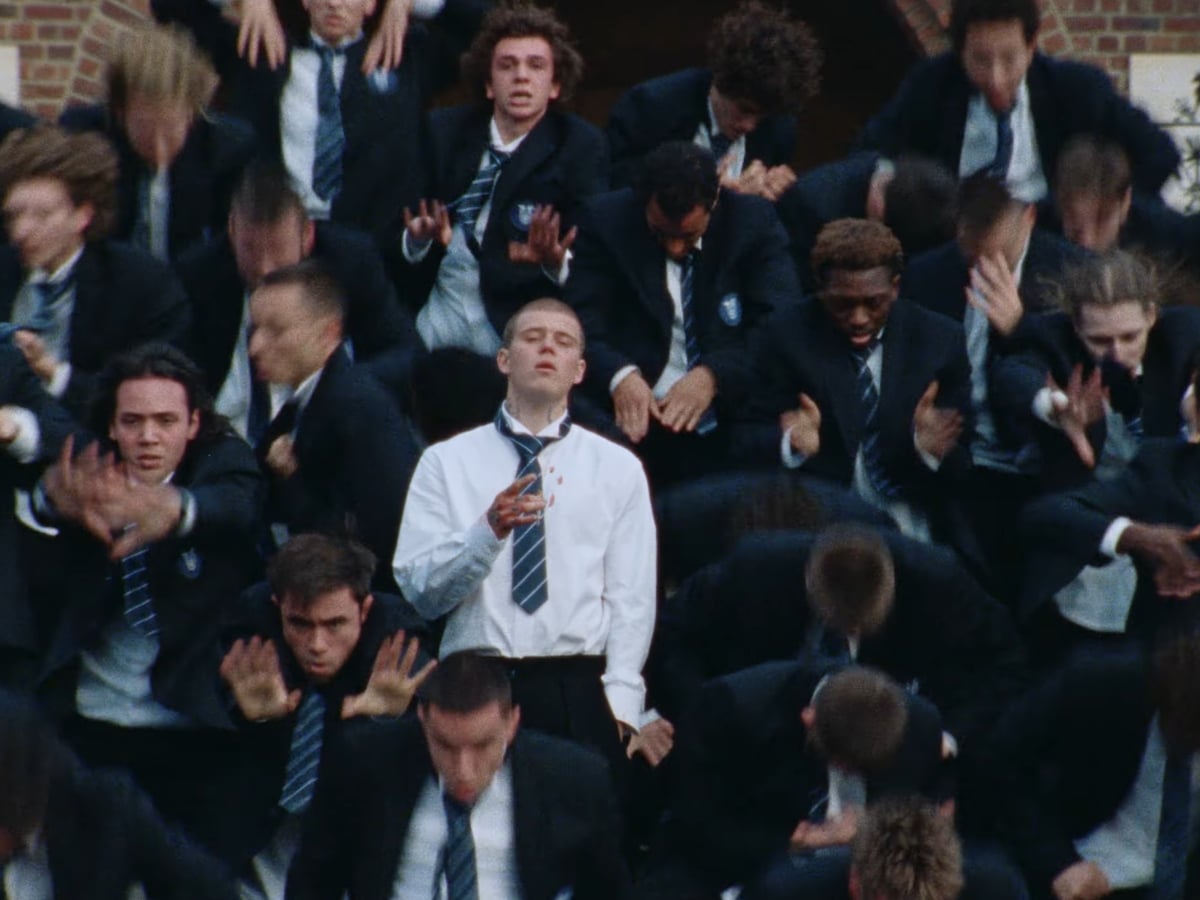
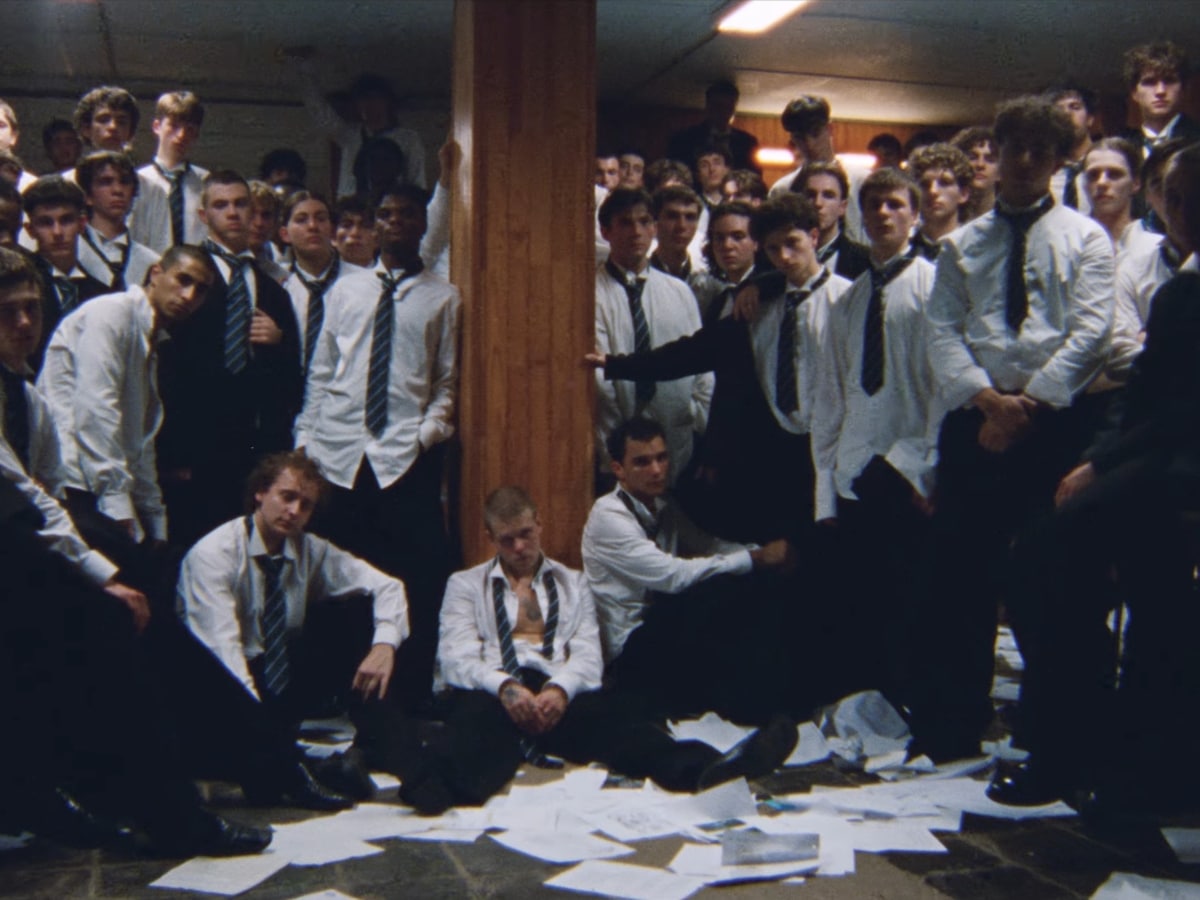
STORM opens on a boarding school corridor and never lets you feel safe in it. Romain Gavras establishes the world — elite uniforms, stripped-back classrooms, no adults anywhere in sight — before introducing Yung Lean as its gravitational centre. He is not playing a character so much as occupying a force of nature: the bully who does not need to raise his voice because the room has already reorganised itself around him. What follows is seven minutes of controlled social pressure, a slow accumulation of dares, damage, and submission that builds not towards a plot but towards a state.
What makes STORM formally exceptional is how Gavras refuses conventional music video logic. There is no performance-for-camera, no lip sync, no cutting rhythm tethered to the beat. The film moves according to its own internal pressure. Tension accumulates through proximity and permission — who is allowed to stand where, who flinches, who does not. The school as setting is not incidental. It is the argument. Every institution has its own hierarchy of violence, and STORM locates that hierarchy with ethnographic precision.
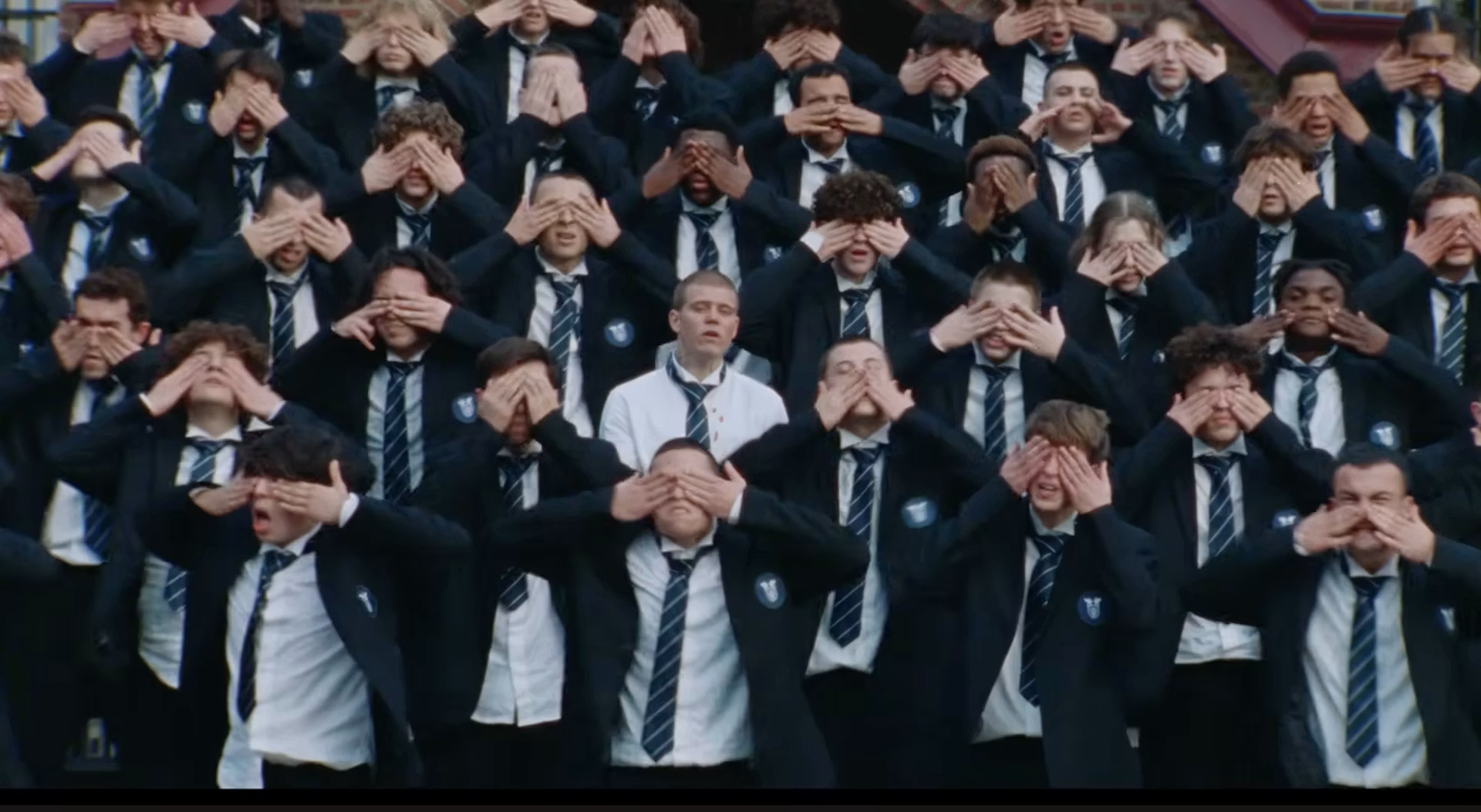
The final sequence is where the film earns its title. Choreographer Damien Jalet turns the assembled students into a single organism — bodies folding and colliding in a mass movement that is somewhere between ritual and riot. It does not release the tension that has been building. It transforms it into something else entirely, something that feels less like resolution than like the moment a storm arrives. The frame fills with movement and the film ends inside it, refusing to let you see where the energy goes. That refusal is the point.
Filmmaker Insight and Production Context
STORM is the latest chapter in a sustained creative partnership between Gavras and Surkin (Benjamin Morando), the French producer who records as GENER8ION. Their collaborations span more than a decade, from The New International Sound (Part II) to Neo Surf (2021), each film building on the last in formal ambition and scale. STORM combines two tracks — Storm I and Storm II — into a single seven-minute film, a structural decision that gives Gavras room to build the kind of sustained atmosphere that most music videos abandon after ninety seconds.
The film was shot in Leeds, set in 2034, and produced by Iconoclast — the production company behind some of Gavras's most significant work. Choreographer Damien Jalet, whose movement language blurs the line between contemporary dance and physical theatre, designed the final sequence that defines the film's climax. Creative direction came from Surkin himself, with styling by Charlotte Buchal giving every uniform and silhouette the quality of a designed world rather than a dressed set. Yung Lean's casting is part of the film's argument: his transition from rapper to actor began here, in a role that required no dialogue and complete physical authority.
Gavras has always treated music videos as a director's form rather than a promotional one. His best work — Justice's Stress, M.I.A.'s Bad Girls, Jamie xx's Gosh — each functions as a standalone short film with its own internal logic and visual vocabulary. STORM extends that lineage, and represents perhaps the most formally ambitious thing he has done in the format. The boarding school is shot with the same rigour and compositional intelligence he brings to his features, and the result is something that rewards multiple viewings in a way very few music videos do.
For Filmmakers: Lessons from STORM
Treat the music video as a director's form, not a promotional one. Gavras has always made films that happen to be set to music. That distinction is everything.
Atmosphere is narrative. STORM has almost no plot, but it generates and sustains more tension than most short films with a three-act structure. What the space feels like is what the film is about.
Choreography is cinematography. The final sequence works because Jalet's movement design and Gavras's frame are solving the same problem from different directions. Collaboration at this level produces something neither discipline could achieve alone.
Institutional settings carry built-in power dynamics. Every school, hospital, prison, or church already has a hierarchy. Place a character inside one and the drama arrives with the location.
Casting is a formal decision. Yung Lean's presence does not require explanation because his physical authority does the work. Who is in the frame shapes what the frame means.
Refuse the beat. STORM does not cut to the music. It builds according to its own internal rhythm, which is far slower and more sustained than any BPM. That refusal gives the film its weight.
Verdict
STORM is seven minutes of sustained social pressure that transforms, in its final moments, into something closer to ritual. Gavras treats the music video format with the seriousness of a feature director and produces the most rewatchable piece of moving image of 2026 so far. It does not explain itself. It does not need to.
⭐ Curated Shorts Pick
Menacing choreographed essential